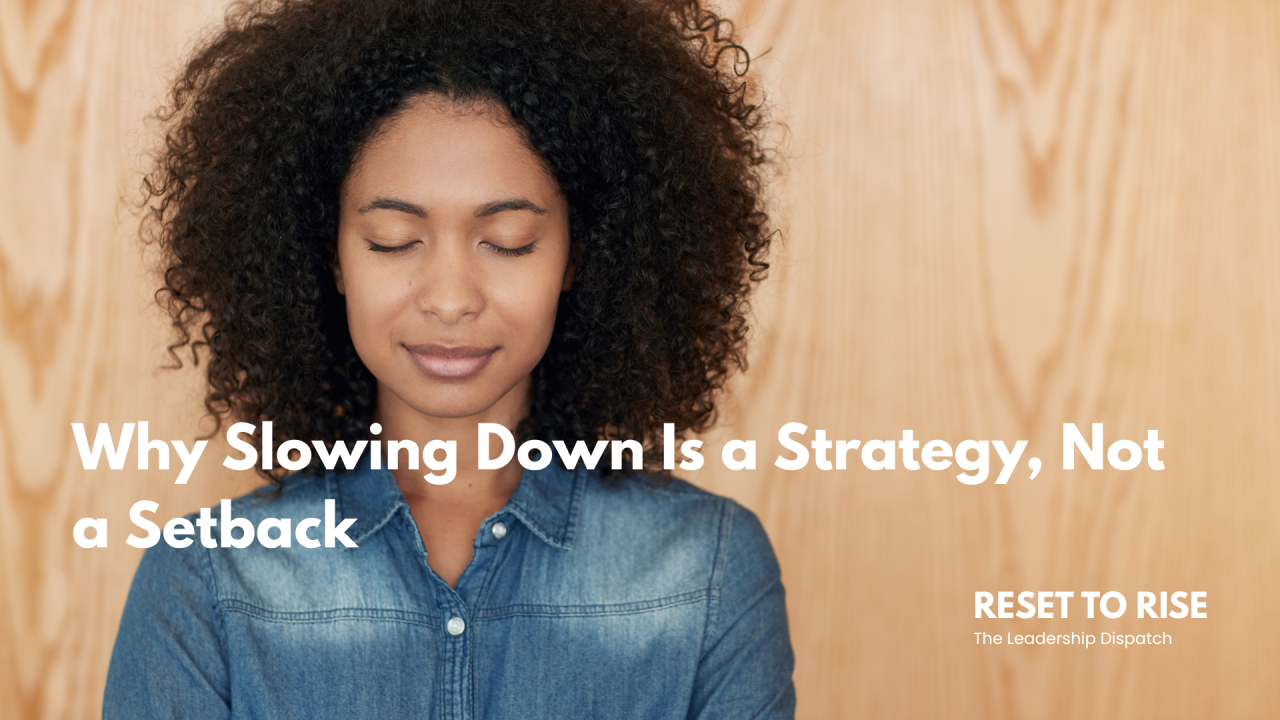
The Power of Pause: Why Slowing Down Is a Strategy, Not a Setback
We are conditioned to equate leadership with motion, be it fast decision-making, constant visibility, and relentless forward momentum.
But what if your next level of leadership isn’t about speeding up? What if the breakthrough you’re chasing actually requires you to slow down?
In a world that rewards urgency, productivity, and performance, the pause can feel like weakness. But in coaching mid-career women navigating transitions, I’ve seen a different truth unfold:
Slowing down isn’t a retreat. It’s a recalibration.
The Neuroscience of Slowing Down
From a brain-based lens, sustained overdrive is not sustainable.
When we operate in a chronic state of urgency, our sympathetic nervous system—the fight-flight-freeze response stays activated. This causes:
- Narrowed attention
- Decreased creativity and emotional regulation
- Impaired decision-making
- Over-reliance on reactive leadership
The prefrontal cortex, which governs strategic thinking, empathy, and long-term planning, starts to shut down under stress. Meanwhile, the amygdala, your fear center takes over.
What looks like “being productive” is often a brain in survival mode.
By slowing down, even momentarily, you allow your nervous system to shift into parasympathetic regulation the state where clarity, insight, and innovation are actually possible.
The Cost of Constant Motion in Leadership
I often coach women who are so used to being in motion- proving, performing, perfecting, that they feel guilt at the idea of slowing down.
They ask:
- “Will I lose my edge?”
- “What if I fall behind?”
- “How do I pause when the world keeps moving?”
But here’s the deeper truth: pace without purpose leads to burnout, not breakthroughs.
What many call a plateau is often a signal to pause, not quit. To reflect, not react. To reconnect with what you’re building, not just how fast you’re building it.
Strategic Pausing Isn’t Inaction. It’s Intentional Leadership.
Here’s what pausing looks like in leadership not as an indulgence, but as a deliberate move:
- Reevaluating priorities before adding more to your plate
- Asking better questions instead of rushing toward answers
- Taking breath between meetings to regulate before reacting
- Giving yourself permission to feel before forcing a performance
These aren’t soft skills. They’re power skills. They lead to better judgment, clearer communication, and higher quality decisions.
From Pause to Power: What It Creates
When mid-career women create space to slow down, here’s what becomes possible:
- Self-leadership: They stop outsourcing decisions and start trusting themselves
- Realignment: They notice where their time, energy, and values are out of sync
- Visibility with clarity: Instead of being busy, they become intentional about how they show up
Slowing down doesn’t mean losing ambition. It means reclaiming direction.
A Coaching Note: When Pause Feels Foreign
If the idea of slowing down feels impossible, you’re not alone. For many high-achieving women, stillness can feel unsafe. Especially if you’ve tied your worth to achievement or movement.
This is why in the Reset to Rise framework, we integrate nervous system awareness into every leadership strategy. You cannot lead clearly from a dysregulated state.
The pause becomes a powerful place to reconnect with your internal compass so your next move is not reactive, but right.
Leadership Takeaway
Leadership isn’t defined by how much you do. It’s defined by the space you create to choose how and why you lead.
Slowing down is not a sign of weakness. It’s a strategic reset. It’s what allows you to return to the table more clear, more grounded, and more aligned.
Your next move doesn’t need to be faster. It needs to be more intentional.
Your Restet Starts Here
If you’re in a season where everything feels urgent, I invite you to pause, just for a moment and ask:
What would change if I stopped performing urgency and started leading from presence?
Subscribe to Reset to Rise: The Leadership Dispatch for weekly coaching insights, brain-based tools, and clarity-building practices for women who are ready to lead from purpose, not pressure.
Because sometimes, the most powerful move is the one you take after you pause.