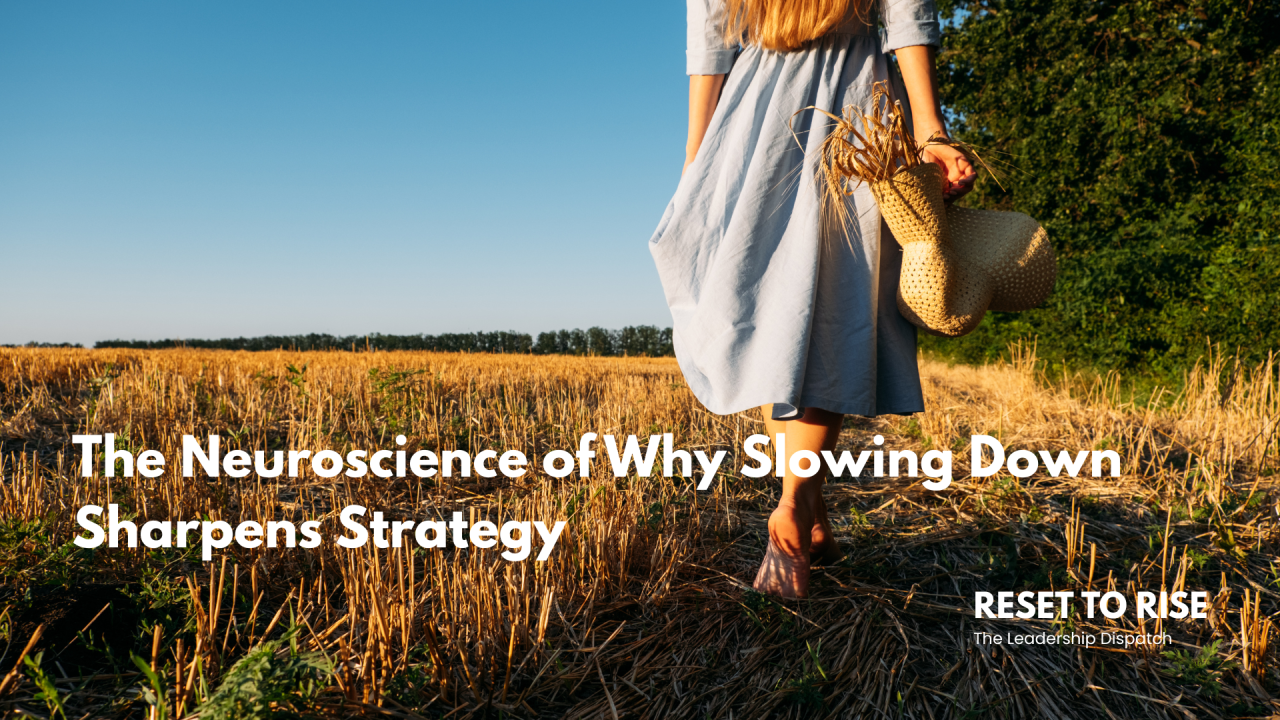
The Neuroscience of Why Slowing Down Sharpens Strategy
We live in a world that glorifies speed, and slowing down almost feels like failure.
Every message leaders receive today celebrates urgency, fast decisions, rapid scaling, constant motion. But here’s the paradox: speed and strategy rarely coexist.
The leaders I coach who make the most intelligent, forward-looking decisions are not the fastest thinkers. They’re the ones who create intentional stillness.
Because while the world rewards movement, the brain rewards moments of pause.
The Neuroscience of Stillness
When you’re always in motion, multitasking, replying instantly, jumping from one meeting to another your brain is operating primarily from what’s called the task-positive network.
It’s brilliant for execution, analysis, and reacting to immediate stimuli. But it’s also energy-intensive and short-sighted. The brain can’t plan long-term or see the system when it’s consumed by the next task.
Strategic thinking requires a shift to a different part of the brain : the default mode network (DMN).
This network activates when you pause, rest, or daydream. It’s the neural system responsible for:
- Integration: connecting the dots between past experiences and future possibilities.
- Perspective: mentally simulating different scenarios.
- Insight: creating new associations beyond linear logic.
Neuroscientist Dr. Mary Helen Immordino-Yang calls this “constructive internal reflection.” It’s the mental space that transforms information into wisdom.
When you’re quiet, your prefrontal cortex (responsible for decision-making and regulation) stops chasing inputs and starts connecting patterns. Your brain moves from effortful thinking to associative thinking the birthplace of strategy, creativity, and foresight.
That’s why your best ideas come in the shower or on a walk. It’s not magic. It’s neurobiology.
What Happens When You Never Pause
Without stillness, your brain is stuck in high beta, it is a fast, anxious frequency linked to stress and reactivity. Cortisol rises, the amygdala (your threat detector) stays alert, and your prefrontal cortex, the very region you need for complex reasoning goes offline.
In that state, your leadership shrinks to survival. You can execute. You can perform. But you can’t strategize.
And over time, the absence of reflection creates cognitive rigidity; its the inability to zoom out, imagine alternatives, or innovate under pressure.
Simply put: constant motion trains your brain to react faster, not think better.
Stillness as a Cognitive Strategy
A Harvard Business Review study found that leaders who practiced “structured reflection” for eg- taking 15 minutes at the end of the day to pause and make sense of experiences improved their performance by 23% compared to those who didn’t.
Neuroscientifically, that pause allows memory consolidation. The hippocampus organizes and integrates what you’ve learned, and the brain builds stronger neural pathways for decision-making.
Stillness sharpens clarity not because you’re doing nothing, but because you’re doing integration. It’s not inactivity. It’s incubation.
How to Cultivate Stillness That Strengthens Strategy
- Create Transition Rituals. Before high-stakes moments, take 60 seconds to exhale fully and unclench your jaw. This activates the vagus nerve, shifting your body into parasympathetic calm, the state where executive function returns online.
- Schedule White Space. Protect 1-2 hours a week of unstructured thinking time. No agenda, no tasks. Let the DMN do its quiet work of pattern-making and integration.
- Replace Rush with Reflection. Before reacting to a request, ask: “What’s the context I’m not seeing yet?” That question pulls the brain from immediacy into abstraction, the hallmark of strategic thinking.
- Embed Somatic Anchors. Pair a simple sensory cue (a stretch, a breath, or a walk) with reflection. The body becomes a reminder to slow down. Over time, this trains the nervous system to associate stillness with safety.
The Leadership Reframe
The next evolution of leadership will not be defined by who moves fastest, but by who can access the deepest clarity.
Strategic intelligence isn’t a product of constant motion. It’s a function of regulated stillness.
Stillness doesn’t mean passivity. It means operating from coherence instead of chaos. It’s the space where reactivity dissolves and foresight emerges.
The best leaders I’ve coached don’t push harder when things feel urgent. They pause. Because that’s when the brain stops reacting and starts creating.
Stillness isn’t the opposite of productivity. It’s the source of it.
Inside Reset to Rise, this is the real work. Helping high-achieving women redefine what powerful leadership feels like from the inside out.