
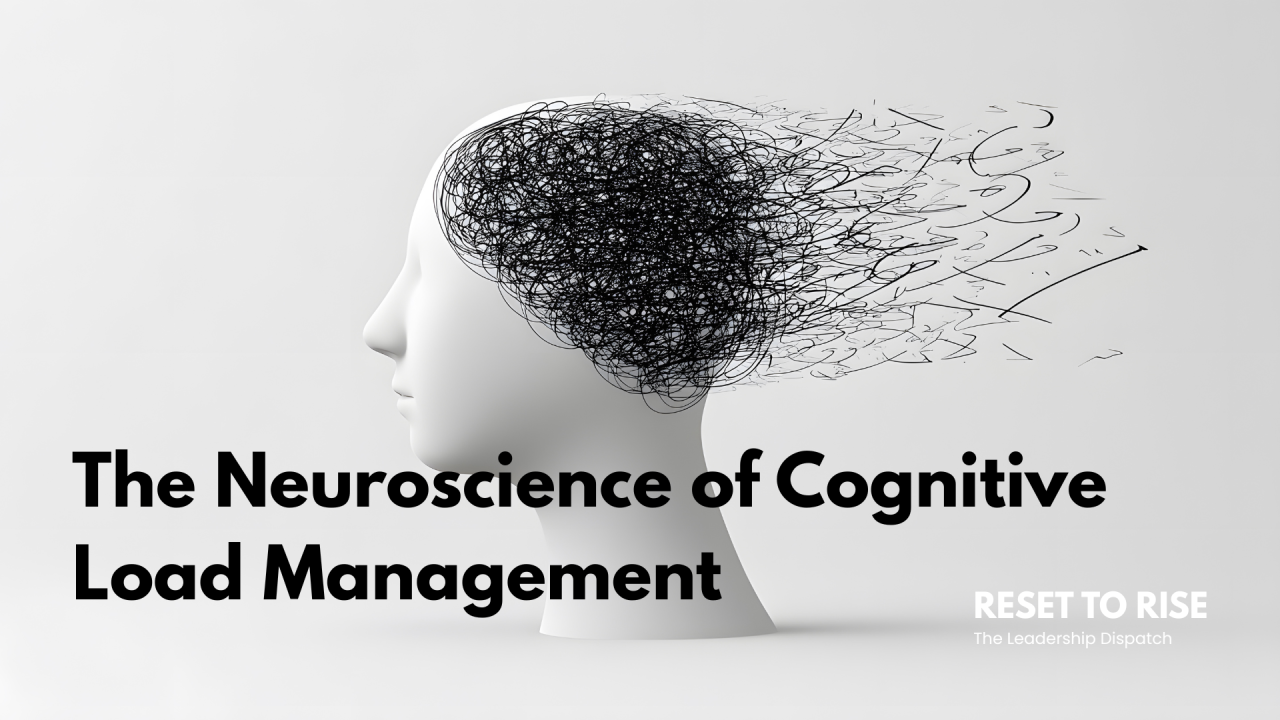
Leadership Without Overwhelm: The Neuroscience of Cognitive Load Management
(Why your brain needs less information to make better decisions)
Most leaders assume burnout comes from long hours, endless meetings, or the pressure to deliver.
But neuroscience tells a different story.
The real problem is not always workload. It is cognitive overload.
Cognitive overload happens when the brain is processing more information than it can effectively manage. Emails, decisions, context-switching, emotional labor, and digital noise all compete for one limited resource: your prefrontal cortex.
This part of the brain is responsible for reasoning, decision-making, empathy, and self-control. It is powerful, but it has a small bandwidth.
When that bandwidth is exceeded, your brain shifts from strategy to survival. Clarity narrows. Creativity declines. Emotional regulation drops. You start reacting instead of leading.
The Brain Under Overload
The prefrontal cortex operates like a high-performance processor. It can handle about four complex variables at once. Beyond that, it begins to offload or skip steps.
Each interruption, notification, or mental switch depletes glucose and oxygen in this region. Psychologists call this attention residue — the lingering mental cost of unfinished tasks. Every time you move from one task to another, your brain carries cognitive leftovers that drain focus.
Chronic context-switching also keeps the amygdala activated. When your brain senses constant urgency, it releases cortisol and adrenaline, preparing for threat. This neuro-chemical loop increases fatigue, shortens attention span, and amplifies emotional reactivity.
The more you chase productivity through speed, the more your brain loses the very resources required for sound judgment.
The Cost of Constant Busyness
Many leaders equate being busy with being valuable. But busyness is a neurological illusion.
Research from Stanford University shows that when the prefrontal cortex is fatigued, decision quality drops by nearly 50 percent. Under overload, the brain defaults to familiar pathways, avoiding risk and innovation. That is why even high-performing leaders start repeating old patterns or micromanaging during stressful periods.
Your brain cannot hold strategy and survival at the same time.
Signs Your Cognitive Load Is Maxed Out
- You reread the same email multiple times without processing it.
- You feel mentally foggy even after sleeping well.
- You find small decisions unusually exhausting.
- You multitask constantly but accomplish less.
- You are short-tempered, distracted, or detached.
These are not personality flaws. They are neurobiological signs of an overworked prefrontal cortex.
Cognitive Load Management for Leaders
1. Reduce switching costs. Batch similar tasks together. The brain processes information faster when it stays within one category of focus.
2. Schedule decision time. Make high-impact decisions early in the day when glucose and attention are highest. By afternoon, the brain’s executive resources are depleted.
3. Protect white space. Reflection is not rest; it is strategic recovery. The default mode network activates during downtime, allowing insight and long-term thinking to emerge.
4. Externalize memory. Write things down. Offloading information from working memory reduces strain on the prefrontal cortex.
5. Audit your inputs. Every notification, meeting, or Slack message consumes neural energy. Ask: “Does this input serve clarity or clutter it?”
The Leadership Reframe
Cognitive capacity is the new competitive advantage. The leaders who protect their mental bandwidth will outperform those who glorify busyness.
Your team does not need a leader who does more. They need one who thinks clearly.
When your brain has space, your leadership gains precision. You stop managing noise and start directing focus. You stop reacting to everything and start shaping what truly matters.
Leadership without overwhelm is not about doing less. It is about thinking better.
Inside Reset to Rise, this is the real work. Helping high-achieving women redefine what powerful leadership feels like from the inside out.